Japanese vs Western Knife Handle: Which Style Is Right for Your Kitchen?
⚡ Quick Verdict
Japanese handles win for lightweight precision work, long prep sessions, and cooks who prefer a pinch grip. Western handles win for durability, heavy-duty tasks, and cooks who want a familiar, confidence-inspiring feel straight out of the box. Neither is objectively better — they’re built around fundamentally different philosophies of how a knife should work.
The handle on your kitchen knife isn’t just a place to put your hand. It’s the entire interface between you and the blade — and the difference between a Japanese wa-handle and a Western-style yo-handle goes far deeper than aesthetics. After years of shopping at knife shops in Sakai and Seki, handling hundreds of knives, and cooking daily with both styles, I can tell you that choosing the wrong handle for your grip style and cooking habits is one of the most common (and easily avoidable) mistakes home cooks make. This guide breaks down every meaningful difference so you can invest in the right knife the first time.
Quick Comparison Table
| Feature | Japanese Handle (Wa-style) | Western Handle (Yo-style) |
|---|---|---|
| Shape | Octagonal, D-shaped, or oval | Contoured, symmetrical curves |
| Material | Ho wood, magnolia, pakkawood, buffalo horn | Synthetic polymer, micarta, G10, wood |
| Tang | Hidden (partial/rat-tail tang) | Full tang (visible through handle) |
| Weight | Very light (15–40g typical) | Heavier (60–120g typical) |
| Balance point | Forward, near blade | At or near the bolster |
| Repairability | Handle replaceable | Handle typically permanent |
| Grip style suited | Pinch grip | Hammer or pinch grip |
| Entry price | ~$30 (basic) | ~$40 (basic) |
| Top-end examples | Yoshimi Kato, Takayuki, Sakai Takayuki | Wüsthof Classic, Victorinox Fibrox, Zwilling |
Japanese Knife Handle (Wa-Handle) Overview
The wa-handle — wa (和) simply meaning “Japanese” — has been refined over centuries of blade-making tradition in cities like Sakai and Seki. Walk into any serious knife shop on Sakai’s Hamono-dori and you’ll immediately notice how handles are often sold separately from the blades, because they’re considered a replaceable, customisable component. That philosophy tells you a lot about how Japanese craftspeople think about handles: functional, purposeful, and personal.
Structurally, wa-handles attach to the blade via a hidden tang — a thin metal spike that inserts into the handle and is secured with a tight friction fit, sometimes with a small collar (the machi or ferrule) made from buffalo horn or plastic. The handle itself is most commonly made from ho wood (magnolia), a soft, light, slightly porous wood that absorbs sweat and provides surprisingly good grip even when wet. Higher-end options use ebony, rosewood, or stabilised pakkawood.
The shapes are where things get interesting. Octagonal handles are the most popular among serious cooks — the eight flat faces give your fingers clear tactile feedback about blade orientation without looking down. D-shaped handles (asymmetric, with a flat side and a rounded side) are traditional on single-bevel knives and are technically handed (right or left). Oval handles are the most neutral and beginner-friendly.
Because the handle is so light — often under 30 grams — the balance point shifts forward toward the blade. This suits the Japanese pinch grip, where your index finger and thumb grip the blade itself just ahead of the handle, making the handle almost a counterweight rather than the primary contact point.
Best for: Pinch-grip users, lightweight preference, long prep sessions, those who want to customise or replace handles over time.
Western Knife Handle (Yo-Handle) Overview
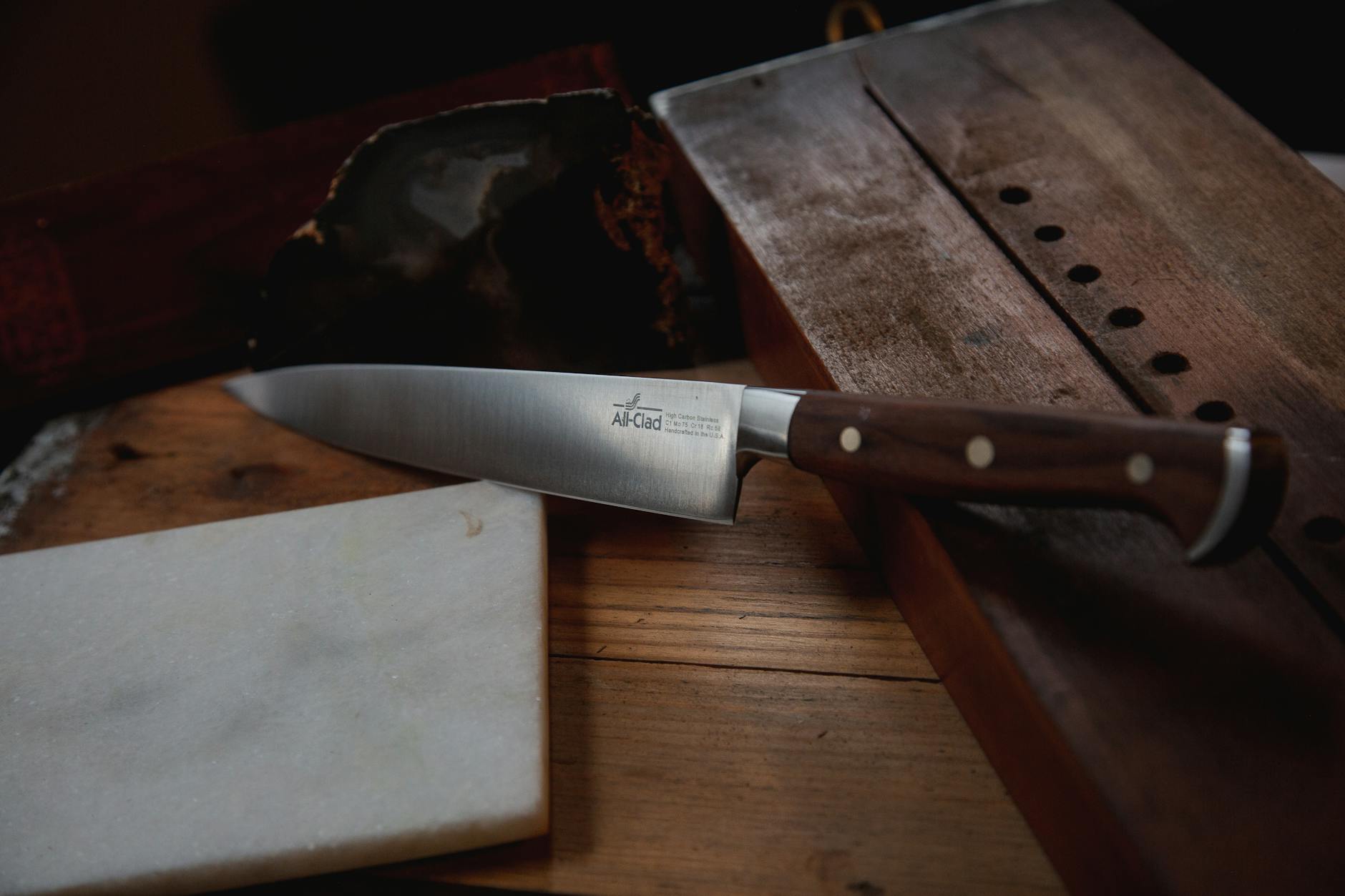
The Western yo-handle (洋, yo, meaning “Western/foreign”) represents a completely different engineering philosophy. Here, the handle isn’t a separate component — it’s an integral part of the knife’s structure. A full tang means the steel of the blade extends all the way through the handle, with two handle scales (called slabs) riveted or bonded to either side. This creates an extremely strong, unified tool that can take serious abuse without the blade ever loosening.
Walk into any kitchen supply store in the US, UK, or Australia and this is the style you’ll find everywhere: Wüsthof, Zwilling, Victorinox. The familiar triple-riveted black handle on a Wüsthof Classic is arguably the most recognisable knife handle in the Western world, and for good reason — it’s been refined over 200 years of German knife-making in Solingen.
Materials vary enormously. Budget knives use polypropylene or basic ABS plastic, which is hygienic and dishwasher-safe but uninspiring. Mid-range knives often use Fibrox (Victorinox’s textured thermoplastic elastomer) or POM (polyoxymethylene), both of which offer excellent grip when wet. High-end handles use Micarta, G10 fibreglass, or natural wood with resin stabilisation.
The bolster — the thick metal collar between blade and handle — is a defining feature of many Western knives. It adds weight, protects the fingers, and shifts the balance point backward toward the hand. Combined with the heavier handle, this creates a more neutral or handle-heavy balance that many cooks find reassuring, especially for rocking cuts and heavy chopping.
Best for: Hammer-grip users, heavy-duty kitchen tasks, those wanting maximum durability and low maintenance.
Head-to-Head Comparison
Steel & Edge Retention
This is where the handle comparison bleeds into overall knife design — because Japanese and Western handles typically appear on knives with very different steel characteristics.
Japanese knives typically use harder steel (62–67 HRC on the Rockwell scale), which holds a razor edge longer but is more brittle and prone to chipping if used carelessly. Western knives typically run softer steel (56–60 HRC), which is tougher, more forgiving, and easier to sharpen but needs more frequent honing.
The lighter wa-handle complements hard Japanese steel perfectly: you’re making precise, controlled slices rather than aggressive chopping, which reduces lateral stress on the blade. The heavier yo-handle suits the more forgiving Western steel — you can use a rocking motion, push-cut through harder vegetables, and not worry as much about technique.
Winner: Depends entirely on your cooking style. Japanese steel + wa-handle for precision; Western steel + yo-handle for versatility and forgiveness.
Handle & Ergonomics
This is the core of the debate. The wa-handle’s octagonal geometry is genuinely brilliant once you’ve used it for a few weeks — the flat faces telegraph blade angle directly to your fingers, reducing wrist fatigue during long prep sessions. Experienced cooks at the restaurants I’ve visited in Osaka almost universally use wa-handled knives for exactly this reason.
However, wa-handles are not ambidextrous in the same way as Western handles. D-shaped wa-handles are specifically sided. Octagonal handles are neutral but the asymmetric balance (blade-heavy) takes adjustment if you’re coming from a Western knife.
Western handles are immediately comfortable for most people because they mirror the shape of the hand. Contoured curves, finger grooves (on some models), and the bolster’s finger guard all make the knife feel secure from the first use. The tradeoff is that this security can encourage a tighter, more fatiguing grip over long sessions.
Winner: Wa-handle for experienced cooks doing long prep; yo-handle for beginners and those doing varied, heavy tasks.
Balance & Weight
A typical wa-handled gyuto (Japanese chef’s knife) might weigh 150–180g total, with the handle contributing perhaps 25–35g. The balance point sits 1–3cm ahead of the bolster, in the blade.
A comparable Western chef’s knife weighs 220–280g, with the handle contributing 80–120g. The balance point sits at or just behind the bolster.
Neither is wrong. Blade-forward balance amplifies the knife’s natural cutting momentum — useful for thin slicing and fine knife work. Handle-forward balance gives a sense of control and reduces wrist fatigue during rocking cuts.
I’ll be honest: when I first switched to a wa-handled knife full-time, the blade-heavy feel was disorienting for about a week. After that, I couldn’t go back for fine work. But when I’m breaking down a whole chicken or cutting through a butternut squash, I still reach for my heavier Western knife.
Winner: Tie — different balance philosophies suit different tasks.
Price & Value
| Price Point | Japanese Wa-Handle | Western Yo-Handle |
|---|---|---|
| Budget (~$30–60) | Tojiro DP Series, basic ho wood handles | Victorinox Fibrox, Mercer Culinary |
| Mid-range (~$80–150) | Sakai Takayuki, Masamoto VG | Wüsthof Gourmet, Global G-Series |
| Premium ($200+) | Yoshimi Kato, Nakagawa, custom handles | Wüsthof Ikon, Miyabi Birchwood, Shun Premier |
One underappreciated advantage of wa-handles: replaceability. A quality wa-handle can be replaced for $15–40 if it cracks, warps, or you simply want an upgrade. Western handles, being structurally integral, cannot be replaced without professional work. Over a 10-year knife ownership period, this matters.
Winner: Wa-handle for long-term value; yo-handle for upfront value at the budget tier.
Maintenance
Wa-handles require a bit more care. Ho wood should never be soaked or put in the dishwasher — occasional light ooning with food-grade mineral oil keeps it from drying and cracking. In Japan’s humid summers this isn’t an issue, but in dryer climates (like much of Australia or the US Southwest), it needs attention a few times a year.
Western handles — especially polymer, G10, or Micarta — are nearly maintenance-free. Wipe clean, occasionally oil if wood is used. Many are technically dishwasher-safe (though I’d never recommend it for any quality knife).
The hidden tang on wa-handles can, over decades, loosen if the wood dries significantly. This is easy to fix (a few drops of water swells the wood back tight, or a knife shop re-sets it in minutes), but it’s a consideration.
Winner: Western handle for low-maintenance households; wa-handle for those willing to invest a little care.
Which Should You Choose?
Choose a Japanese wa-handle if:
– You already use or want to learn a pinch grip
– You do a lot of fine prep work — julienning, brunoise, thin slicing of proteins
– You want a lightweight knife for long cooking sessions
– You enjoy the idea of customising or upgrading your handle over time
– You’re comfortable with slightly more knife care and technique
Choose a Western yo-handle if:
– You’re a beginner or infrequent home cook who wants confidence immediately
– You do a lot of heavy-duty cutting — breaking down large vegetables, occasional bones, bread
– You want minimal maintenance and a nearly indestructible handle
– You prefer a heavier, more substantial feel in hand
– You use a hammer grip and find blade-heavy knives uncomfortable
The honest answer for most home cooks: Start with a Western-handled knife to build fundamentals, then add a wa-handled Japanese knife once you’ve developed your grip and want to explore more precise cutting techniques. I keep both styles in my kitchen in Osaka — they genuinely serve different purposes.
Frequently Asked Questions
Q: Can I put a wa-handle on a Western blade, or vice versa?
Yes, but it requires custom work. Some bladesmiths and knife shops (including several I’ve visited in Sakai) will re-handle a blade to your specification. Expect to pay $30–80 for a quality re-handle. It’s more common to put a wa-handle on a Japanese blade than to mix styles, but it’s absolutely done.
Q: Are wa-handles hygienic? The wood seems porous.
Traditional ho wood is naturally antimicrobial and the porosity is very slight. Millions of Japanese professional cooks use wooden wa-handles daily without issue. The key is not soaking the handle and drying the knife promptly after washing. Pakkawood (resin-stabilised wood) wa-handles are essentially non-porous and an excellent middle ground.
Q: I have large hands — is a wa-handle too small for me?
Not necessarily. Wa-handles come in multiple lengths (typically 135mm to 165mm) and the octagonal shape actually accommodates a range of hand sizes well because you’re not fighting a contoured grip. That said, if you have very large hands and use a hammer grip, a Western handle with a longer, wider profile may be more immediately comfortable. Try before you buy if possible — many Japanese kitchen stores in major cities have display knives you can handle.
Q: Do professional chefs prefer Japanese or Western handles?
It genuinely depends on the cuisine and region. In Japan, virtually all professional Japanese cooks use wa-handled knives. In Western restaurant kitchens, yo-handles dominate. In high-end fusion and omakase restaurants globally, you’ll see both — often the same chef using a wa-handled yanagiba for fish and a yo-handled boning knife for butchery. It’s about the right tool for the task, not brand loyalty.
All prices mentioned are approximate USD retail as of 2026. Knife specifications vary by manufacturer and model — always verify current specs before purchasing.